Poster Presentation RACI Biomolecular Division Conference 2013
Synthesis of norbornane-peptide hybrids as potential antibiotics (#103)
Antibacterial resistance is a critical issue that is encountered by medical practitioners worldwide in their attempts to treat bacterial infections. A decline in the number of pharmaceutical companies pursuing new therapeutics, in combination with the continued misuse of antibiotics only serves to exasperate the problem. In particular, nosocomial ‘superbugs’ have proven to be a major source of concern as their widespread resistance against the majority of available antibiotics makes treatment difficult. Due to the ability of multi-drug resistant gram-negative bacteria to rapidly manifest resistance to antibiotics, they continue to pose a great risk to public health.
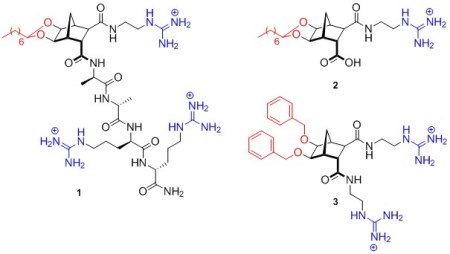
In our pursuit of novel antibiotics, a conformationally rigid series of amphiphilic compounds based on a norbornane scaffold have been synthesised. Peptidomimetics such as compound 1 were synthesised by coupling pre-functionalised norbornane scaffolds such as compound 2, to short cationic peptides using Solid Phase Peptide Synthesis (SPPS). In order to construct these norbornane frameworks both linear and convergent multi-step synthetic routes were investigated. In order to probe for SAR activity, incorporation of multiple lipophilic regions (as highlighted in red) onto the norbornane framework, such as compound 3, has been achieved.
The norbornane scaffold allows for discriminatory functionalisation and promotes a pre-organised system. These peptidomimetics offer the potential of a more stable compound in vivo, compared to natural cationic peptides, making them attractive as new antibiotics targeting gram-negative bacteria.