Poster Presentation RACI Biomolecular Division Conference 2013
Structure-based design of a-helical mimetic inhibitors of pro‑survival Bcl-2 proteins (#99)
Alteration of programmed cell death response due to over-expression of pro-survival proteins such as Bcl‑xL, Bcl-2, and Mcl-1 or down-regulation of pro-apoptotic BH3-only proteins is a key driver in cancer initiation, progression and of resistance to chemotherapy. Notably, most anti‑cancer drugs depend on a functional apoptotic machinery to elicit their activity. Thus, restoring the proper unraveling of Bcl-2 family-driven apoptosis by mimicking the activity of the BH3-only proteins with small molecules provides a potential strategy for the development of anticancer therapies.
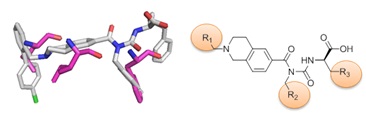
We employed a structure-based approach to design novel peptidomimetics of the BH3-only proteins targeting the pro-survival protein Bcl-xL. Our design was guided by the X-ray structure of the Bim/Bcl-xL complex, which reveals that the Bim-BH3 peptide adopts a helical conformation, and projects four hydrophobic residues on one face of the α-helix into four corresponding hydrophobic pockets located within the binding cleft of Bcl-xL. Our molecular scaffold uses a benzoylurea core functionalised tomimic three hydrophobic side chains of the Bim-BH3 peptide. We demonstrate how our highly modular synthesis enables an extensive Structure-Activity Relationship (SAR) study affording benzoylureas with nanomolar affinity for Bcl-xL. Investigations into the SAR of the series and the underpinning chemistry will be presented, and the critical structural data obtained via X-ray crystallography and the computational techniques used to design the benzoylurea peptidomimetics will be discussed. Overall, our work affords a unique series of validated inhibitors of the Bcl-2 family of proteins.