Poster Presentation RACI Biomolecular Division Conference 2013
The Design and Synthesis of Selective α7 nAChR Agonists (#54)
Nicotinic acetylcholine receptors (nAChRs) are ion channels gated by acetylcholine (ACh), one of the major excitatory transmitters in the nervous system. The α7 nAChR subtype is expressed in brain regions associated with cognitive function, and reduced density of α7 nAChRs is evident in both schizophrenia and Alzheimer’s disease (AD). Prototypical α7 nAChR agonists have been shown to enhance a variety of cognitive behaviors in animal models and to normalize sensory gating deficits, which are believed to contribute to the cognitive fragmentation in schizophrenia.1 A neuroprotective effect is also elicited upon treatment of α7 nAChR agonists on cultured neuronal cells exposed to β-amyloid or deprived of NGF.1 Based on these findings α7 nAChR agonists are predicted to be effective treatment agents for the improvement of cognition in both schizophrenia and AD.
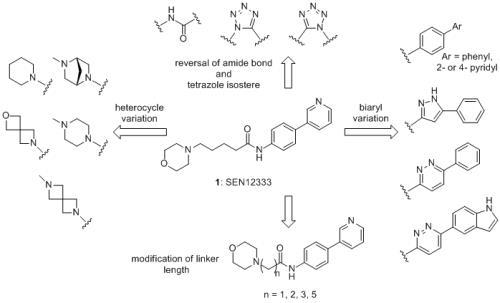
Few selective α7 nAChR agonists have been reported, and none show sufficient brain penetrability or optimal pharmacokinetics for clinical utility.2 SEN12333 (1) was recently identified as an orally bioavailable, brain-permeable, small molecule agonist of α7 nAChR, albeit of low potency. With the objective of improving potency and maintaining selectivity at the α7 nAChR, systematic modification of the biaryl and heterocyclic rings, the amide bond, and the alkyl linker of SEN12333 have been explored.3 Details of the synthesis, receptor binding, and functional activity of a library of more than 50 compounds will be presented, and will highlight the structural features essential for α7 nAChR selectivity, affinity, and efficacy.
- Behavioural Brain Research (2000), 113, 169-181
- Bioorganic and Medicinal Chemistry (2009), 17, 5247-5258
- Bioorganic and Medicinal Chemistry Letters (2012), 22, 2380-2384