Poster Presentation RACI Biomolecular Division Conference 2013
Breaking Bad: The Clandestine Rational Design of Cannabimimetic Indoles as Drugs of Abuse (#53)
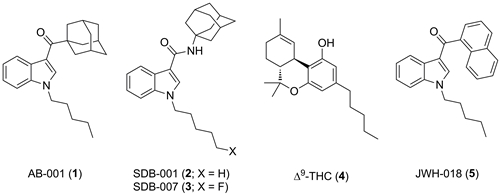
Herbal blends containing synthetic cannabimimetic additives have been available globally from internet-based vendors as unregulated, “legal” cannabis substitutes since about 2004. Since 2008, more than 45 synthetic cannabinoid (CB) receptor agonists from several structural classes have been identified in seized products, with 23 reported in 2011 alone.1 Like other historical “designer drugs”, the structures of many clandestinely produced synthetic cannabimimetics were originally reported by academic or industrial research laboratories. However, hitherto unknown AB-001 (1) was identified in Ireland and Hungary in 2011, followed by the similarly unprecedented SDB-001 (2) in Japan in 2012, both in products intended for human consumption.23 More recent fluorinated examples, like SDB-007 (3), have been implicated in cases of severe nephrotoxicity in humans. The structures of AB-001, SDB-001, and SDB-007 exploit existing structure-activity relationships surrounding indole CB receptor ligands, and are likely the products of clandestine rational drug design by unknown medicinal chemists.
The synthesis of AB-001, SDB-001, and a diversity of analogues was undertaken to address the conflicting anecdotal reports of the psychoactivity of AB-001 in humans, and the complete absence of information regarding the activity of SDB-001 in any animal.4 The agonist activity of all compounds at CB1 and CB2 receptors was confirmed using a FLIPR membrane potential assay. The effects of selected compounds in rats were compared to naturally-occurring Δ9-tetrahydrocannabinol (Δ9-THC, 4) and established synthetic cannabimimetic JWH-018 (5) using biotelemetry. Like Δ9-THC and JWH-018, SDB-001 dose-dependently induced hypothermia and reduced heart rate, while AB-001 did not. AB-002, a homologue of AB-001 containing the ketone tether of AB-001 but approximating the indole-adamantane spacing of SDB-001, was also devoid of activity in vivo. Details of the current work and ongoing efforts to anticipate design trends for emergent cannabimimetics will be presented.
- EMCDDA–Europol 2011 Annual Report on the implementation of Council Decision 2005/387/JHA.
- Grigoryev, A., Kavanagh, P., Melnik, A. Drug Test. Anal. 2012, 4, 519-524.
- Uchiyama, N., Kawamura, M., Kikura-Hanajiri, R., Goda, Y. Forensic Toxicol. 2012, 30, 114-125.
- Banister, S. D., Wilkinson, S. M., Longworth, M., Stuart, J., Apetz, N., English, K., Brooker, L., Goebel, C., Hibbs, D. E., Glass, M., Connor, M., McGregor, I. S., Kassiou, M. ACS Chem. Neurosci. 2013, in press (DOI: 10.1021/cn400035r).