Poster Presentation RACI Biomolecular Division Conference 2013
Novel classes of iminosugars as broad-spectrum antiviral agents (#88)
1. Introduction
The most remarkable and promising group of inhibitors of glycosidases is the iminosugars.Theseare carbohydrate mimetics (glycomimetics) in which the endocyclic ring oxygen has been replaced by an amine.1
Glycosidases are enzymes involved in a range of anabolic and catabolic processes, including the lysosomal catabolism of glycoconjugates, intestinal digestion, biosynthesis of glycoproteins, quality control systems in the endoplasmic reticulum (ER) and ER-associated degradation of glycoproteins. The biological activities of iminosugars, and the marketing of a number of successful drugs based on iminosugar scaffolds, continue to indicate their potential as effective therapeutic agents2 in the management and treatment of many medical conditions, including diabetes,3 lysosomal storage diseases,4 viral infections5 and cancer.6 Synthetic routes to novel classes of iminosugar analogues continue to be developed, which keep delivering more chemical space and improved SAR data. These include the addition of branched carbon chains7 - shown to confer potent biological activities7,8 -, the use of click chemistry for library generation9 , the achievement of constrained azetidine analogues.10
2. Results and Discussion
We are interested in the synthesis of iminosugars which display broad-spectrum antiviral activities via the targeting of the N-glycan processing pathway of host cells.7b We are currently synthesising a novel class of DNJ-based iminosugars, which are expected to display improved selectivity, potency and toxicity profiles. The latest results on the synthetic investigations towards these novel iminosugars from carbohydrate starting materials L-sorbose and D-glucose via divergent synthetic pathways are presented (Scheme 1.).
3. Conclusions
Synthetic routes towards these novel classes of iminosugars are being developed. Biological evaluations will follow as soon as the target molecules are synthesized.
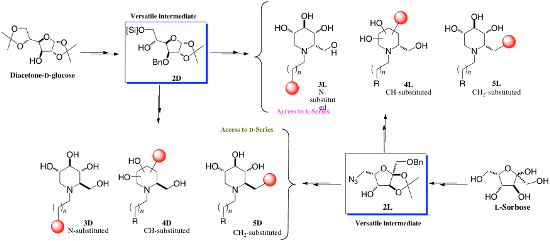
Scheme 1. Synthetic pathways
- Afarinkia, K.; Bahar, A. Tetrahedron: Asymm. 2005, 16, 1239–1287.
- a) Nash, R. J.; Kato, A. et al., G. W. J. Fut. Med. Chem. 2011, 3, 1513–1521; b) Houston, T. A., Blanchfield, J. T., Mini-Rev. Med. Chem. 2003, 3, 669; c) Kato, A., Kato, N. et al., J. Med. Chem. 2005, 48, 2036-2044.
- a) Watson, A. A.; Fleet, G. W. J. et al. Phytochemistry 2001, 56, 265–295; b) Kato, A., Hayashi, E. et al. J. Med. Chem. 2012, 55, 10347-10362.
- Rountree, J. S. S.; Butters, T. D. et al. ChemMedChem 2009, 4, 378–392.
- Dwek, R. A.; Butters, T. D. et al., Nat. Rev. Drug Disc. 2002, 1, 65–75.
- Fiaux, H.; Kuntz, D. A. et al., Bioorg. Med. Chem. 2008, 16, 7337–7346.
- a) Soengas, R. G.; Simone, M. I. et al., Eur. J. Org. Chem. 2012, 12, 2394-2402; b) Simone, M. I.; Edwads, A. A. et al., Tetrahedron: Asymm. 2008, 19, 2887–2894; c) Risseeuw, M. D. P.; Overhand, M.; Fleet, G. W. J.; Simone, M. I. Tetrahedron: Asymm. 2007, 18, 2001–2010; d) Hotchkiss, D.; Soengas, R.; Simone, M. I. et al. Tetrahedron Lett. 2004, 45, 9461–9464.
- a) Best, D.; Jenkinson, S. F. et al. Tetrahedron Lett. 2010, 51, 4170–4174; b) Simone, M. I.; Soengas, R. G. et al. Tetrahedron: Asymm., 2012, 23, 401-408.
- Wilkinson, B. L.; Bornaghi et al., Aust. J. Chem. 2010, 63, 821.
- Martínez, R. F.; Araújoa, N. et al., Bioorg. Med. Chem. 2013, doi.org/10.1016/j.bmc.2013.03.004.