Poster Presentation RACI Biomolecular Division Conference 2013
Synthesis and Biological Evaluation of Glycopeptide Cancer Vaccine Candidates (#61)
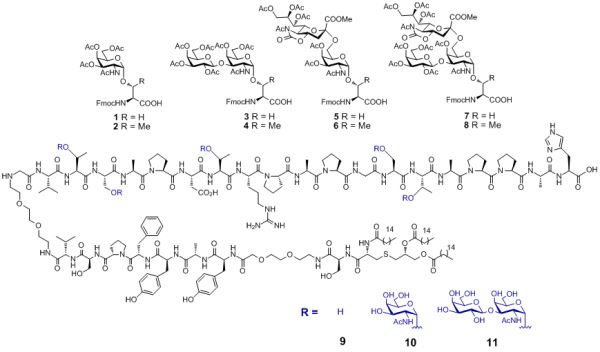
MUC1 is a highly O-glycosylated transmembrane glycoprotein found on the surface of epithelial cells; the extracellular protein domain consists of a 20-amino acid tandem repeat sequence (SAPDTRPAPGSTAPPAHGVT) rich in serine and threonine. In epithelial tumours, MUC1 is overexpressed and aberrantly glycosylated, leading to the presentation of several tumour-associated carbohydrate antigens (TACAs).1 The key structural difference between malignant and normal epithelial cells enables selective targeting of tumour-associated MUC1 and is a basis for the development of synthetic MUC1-based cancer vaccines.2
The present work describes the development of new and efficient synthetic routes to access glycosylamino acid building blocks (1-8) bearing four common TACA motifs for incorporation into vaccine glycopeptides. The incorporation of these building blocks into MUC1 tandem repeat sequences has been achieved using Fmoc-SPPS. The MUC1 tandem repeat glycopeptides were subsequently conjugated to a peptide fragment of the tetanus toxin protein YSYFPSV (as a helper T-cell epitope) and/or the immunostimulating Toll-like receptor 2 ligand, Pam3CysSer via pentafluorophenyl ester-mediated fragment condensation reactions. The resulting self-adjuvanting multi-component vaccine candidates (9-11) were shown to elicit a significant IgG antibody response in mice models and to selectively recognize tumourogenic MUC1 expressed on the surface of MCF7 breast cancer cell line over MUC1 expressed on normal cells.3,4
- Apweiler, R.; Hermjakob, H.; Sharon, N. Biochim. Biophys. Acta. 1999, 1473, 4.
- Dube, D.H.; Bertozzi, C.R. Nature Rev. Drug Discovery 2005, 4, 477.
- Wilkinson, B.L.; Day, S.; Malins, L.R.; Apostolopoulos, V.; Payne, R.J. Angew. Chem. Int. Ed. 2010, 50, 1635.
- Wilkinson, B. L.; Day, S.; Chapman, R.; Perrier, S.; Apostolopoulos, V.; Payne, R. J. Chem. Eur. J. 2012, 18, 16540.