Poster Presentation RACI Biomolecular Division Conference 2013
Ellipticine and Analogues by Flow Chemistry (#85)
Our team has recently invested heavily in flow chemistry through the establishment of the Australian Cancer Research Foundation Centre for Kinomics Flow Chemistry Laboratory. Flow chemistry approaches offer the potential benefits of rapid reaction optimisation, high yields, decreased side product generation, reduced purification requirements through the use of solid supported scavengers, and no scale up issues by continuous production.
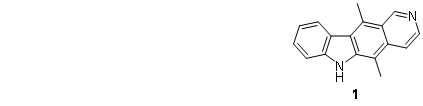
This presentation focuses on our development of flow chemistry strategies for ellipticine (1) (5,11-dimethyl-6H-pyrido[4,3-b]carbazole) and focused analogue libraries. Ellipticines display anticancer properties with a small number of derivatives entering clinical trials. Ellipticine targets DNA topoisomerase I and DNA topoisomerase II.2
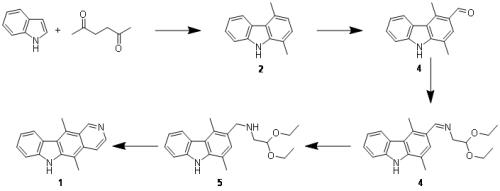
First isolated in 1959, ellipticine has been synthesised by a number of groups, with the most common approach commencing with indole, requiring 6-7 steps in <20% yield.1
In this presentation we examine the synthesis of ellipticine with our initial approach outlined below:
- Fiona M. Deane, Elaine C. O’Sullivan, Anita R. Maguire, Jayne Gilbert, Jennette A. Sakoff, Adam McCluskey and Florence O. McCarthy. Org. Biomol. Chem., 2013, 11, 1334
- Charlotte M. Miller and Florence O. McCarthy. RSC Advances, 2012, 2, 8883–8918