Poster Presentation RACI Biomolecular Division Conference 2013
Synthesis of Thioridazine-VLA-4 Antagonist Hybrids as Multi-Action Agents for Treating Haematological Malignancies (#78)
Novel strategies and therapeutics for treating haematological malignancies and preventing disease recurrence are highly sought after in the cancer arena. One approach is to block VLA-4/VCAM-1 interactions with VLA-4 antagonists which cause rapid mobilisation of malignant early haemopoietic stem and progenitor cells (HSPCs) into the peripheral blood.1 These cells are normally protected in the bone marrow from chemotherapy drugs; an effect known as Environment Mediated Drug Resistance.2 It is postulated that mobilisation of these cells would make them vulnerable to chemotherapy and reduce cancer survival and recurrence.
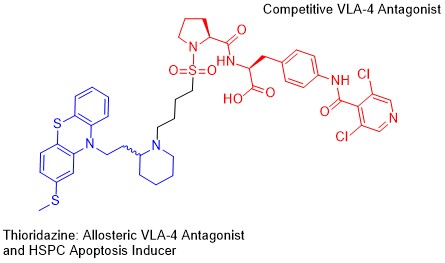
Thioridazine, a discontinued anti-psychotic drug, was recently shown to possess multiple potentially useful activities against haematological malignancies. The compound was shown to act as an allosteric antagonist of VLA-4 leading to HSPC mobilisation.3 It was also shown to selectively induce apoptosis and differentiation in malignant early HSPCs.4 Given these recent findings it was of interest to explore novel multi-action compounds which combine a known VLA-4 antagonist and thioridazine into hybrid molecules and explore their potential as new agents for treating haematological malignancies.
Two epimeric hybrids varying in stereochemistry at the thioridazine C16 chiral carbon were targeted for synthesis in this project. The convergent route was successfully implemented with the respective hybrids being synthesised. During the synthesis a new method was developed for enantiomeric resolution of thioridazine and for obtaining enantio-pure (R) and (S) northioridazine. The compounds will be forwarded to a collaborator at the University of New Mexico (Dr. Alexandre Chigaev) for comprehensive biological testing.
- Chigaev, A.; Smagley, Y.; Zhang, Y.; et al. Biol. Chem. 2011, 286, 20375-20386.
- Meads, M. B.; Gatenby, R. A.; Dalton, W. S. Nat. Rev. Cancer. 2009, 9, 665-674.
- Chigaev, A.; Wu, Y.; Williams, D. B.; et al. Biol. Chem. 2011, 286, 5455-5463.
- Sachlos, E.; Risueno, R.; Laronde, S.; et al. Cell. 2012, 149, 1284-1297