Poster Presentation RACI Biomolecular Division Conference 2013
Novel Sigma Receptor Ligands (#77)
The sigma (σ) receptor is a neuromodulatory protein, widely expressed in the central nervous system (CNS) and to a lesser extent, the peripheral nervous system. They have a broad spectrum of CNS activity and have implications in the pathophysiology of numerous CNS diseases, including, anxiety, depression, schizophrenia, psychosis, Alzheimer’s disease, Parkinson’s disease and drug abuse.1
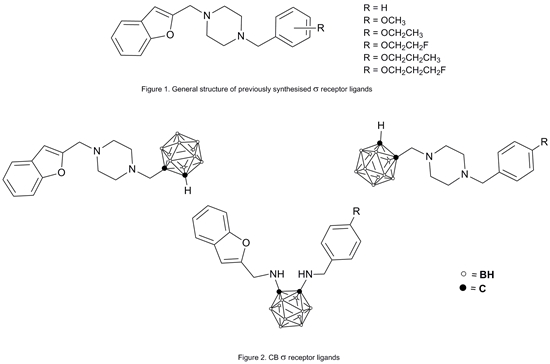
Currently, two σ receptor subtypes are known; σ1 and σ2, differing in molecular weight, pharmacological profile, distribution and function. The design of highly subtype-selective ligands is hindered by a lack of information regarding the σ1/σ2 binding site, as well as an extreme structural heterogeneity of known ligands. Several highly subtype-selective σ1 ligands (Figure 1) have been previously synthesised in the Kassiou laboratory and distinct structure-affinity relationships (SAR) were observed within this series.1 The pharmacophore for σ1 receptors requires an alkylamine core tethering two hydrophobic groups.
Carboranes (CBs) – boron-rich polyhedral cages- have been researched extensively for Boron Neutron Capture Therapy (BNCT), but there has been limited research into the use of CBs as pharmacophores in CNS therapeutics. CBs offer unique properties such as kinetic stability to hydrolysis, pseudo-aromaticity, and the availability of three regioisomers (o-, m- and p-).2 Additionally, the neutral closo-CB can be easily converted to the anionic nido-CB in a single step to modulate lipophilicity. To harness these unique properties offered by CBs, CBs were incorporated into σ receptor ligands as substitutes for benzofuran, aryl ethers and piperazine (Figure 2). A potent and selective σ receptor ligand will aid with the pharmacological characterisation of the σ receptors (role, distribution and disease-state) and provide a treatment to a range of neurological disorders. The synthesis and biological evaluation of these CB analogues and comparison against previously synthesised σ receptor ligands will be presented.
- Moussa, I. A.; Banister, S. D.; Beinat, C.; Giboureau, N.; Reynolds, A. J.; Kassiou, M. Journal of Medicinal Chemistry 2010, 53, 6228.
- Issa, F.; Kassiou, M.; Rendina, L. M. Chemical Reviews 2011, 111, 5701.