Poster Presentation RACI Biomolecular Division Conference 2013
Synthesis and HIV Inhibitory Activity of N-terminal Chemokine Receptor Sulfopeptides (#75)
Tyrosine (Tyr) sulfation, mediated by trans-Golgi localised tyrosylprotein sulfotransferases (TPSTs), is one of the most common post-translational modifications found on secreted and transmembrane proteins.1 Tyrosine sulfation has been shown to be critical for a number of physiological processes including cell-cell adhesion and hormone regulation.1 In addition, sulfation of Tyr residues on the extracellular N-terminal domain of the HIV-1 coreceptor CCR5 has been shown to modulate viral entry into the host cell.2-4
Despite the importance of tyrosine sulfation, the exact biological role of this modification on proteins has, in most cases, not been determined. This is primarily due to the difficulties associated with isolating sulfated peptides and proteins in pure form owing to the extremely acid labile nature of the Tyr sulfate ester linkage. We have recently developed an efficient synthetic methodology for the site selective introduction of sulfation into peptides via the use of orthogonal protecting groups (PG) and a solid-phase sulfation strategy.5 We have used this methodology to prepare eight homogeneous sulfated variants of the CCR5 N-terminal domain. This has enabled a detailed investigation of the role of CCR5 sulfation on HIV binding and host cell entry inhibition to be interrogated. The inhibition of drug resistant HIV cell entry by these sulfopeptides has also been demonstrated for the first time.4
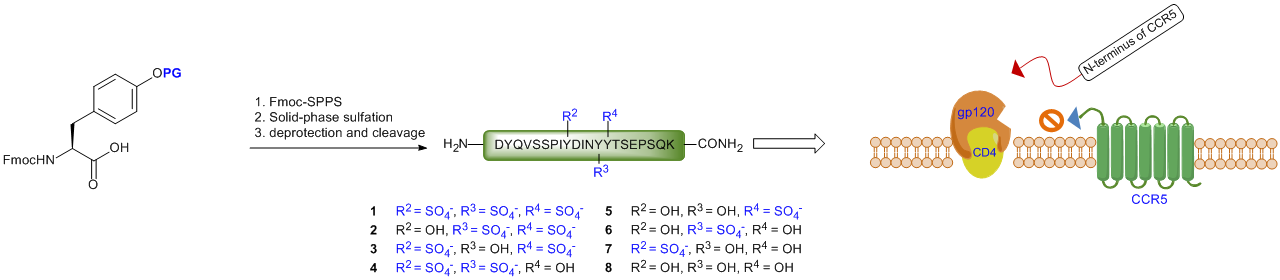
Figure 1 Site-selective sulfation of the CCR5 N-terminal domain via an orthogonal protecting group strategy
- Moore, K. L. J. Biol. Chem. 2003, 278, 24243.
- Farzan, M.; Mirzabekov, T.; Kolchinsky, P.; Wyatt, R.; Cayabyab, M.; Gerard, N. P.; Gerard, C.; Sodroski, J.; Choe, H. Cell 1999, 96, 667.
- Huang, C.-c.; Lam, S. N.; Acharya, P.; Tang, M.; Xiang, S.-H.; Hussan, S. S.-u.; Stanfield, R. L.; Robinson, J.; Sodroski, J.; Wilson, I. A.; Wyatt, R.; Bewley, C. A.; Kwong, P. D. Science 2007, 317, 1930.
- Roche, M.; Salimi, H.; Duncan, R.; Wilkinson, B.; Chikere, K.; Moore, M.; Webb, N.; Zappi, H.; Sterjovski, J.; Flynn, J.; Ellett, A.; Gray, L.; Lee, B.; Jubb, B.; Westby, M.; Ramsland, P.; Lewin, S.; Payne, R.; Churchill, M.; Gorry, P. Retrovirology 2013, 10, 43.
- Taleski, D.; Butler, S. J.; Stone, M. J.; Payne, R. J. Chem. – An Asian J. 2011, 6, 1316.