Poster Presentation RACI Biomolecular Division Conference 2013
Boron Templated Triazole Formation (#81)
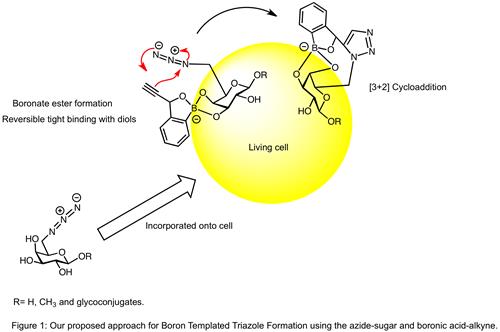
Boron acids are known to have a binding affinity for vicinal diols1. The covalent interaction that occurs between the boron acid and cis-diol has been exploited in the design and synthesis of carbohydrate sensors as well as inhibitors of enzymes2,3. Within some disease states, particular aberrant carbohydrates become potential sensor targets for disease detection4,5. We are developing boron templated triazole formation to target cell-surface carbohydrates for the purposes of potential disease detection, treatment and drug delivery. The proposed chemistry uses boron to provide the initial covalent binding with the carbohydrate of interest thus bringing chemically reactive motifs together allowing a spontaneous reaction of alkyne on the boronated molecule and an azide on the carbohydrate.
The boron templated chemistry shown below (Fig. 1) is being developed using alkyne and azide derivatives that have the potential of induced Huisgen [3+2] cycloaddition. Preliminary analysis has shown that this type of intramolecular delivery can allow the cycloaddition to occur at much lower temperatures (under 50˚C) indicating this approach shows that it is indeed a feasible strategy for the purpose of modifying cell-surfaces.
The synthesis of precursors is in the process of being optimized and a refined second generation of derivatives is being developed. It will ultimately be used with fucose azide derivatives that can be incorporated into cell-surface glycoconjugates. Biologically relevant evaluations will follow once the preliminary chemistry has been optimized.
- Hall, D. Boronic acids - Preparation, Applications in Organic synthesis and Medicine; 3rd ed.; Wiley-VCH, 2008.
- James, T. D.; Phillips, M. D.; Shinkai, S. Monogr Supramol Chem 2006, 1.
- Trippier, P. C.; McGuigan, C. MedChemComm 2010, 1, 183.
- Pappin, B.; Kiefel, M. J.; Houston, T. A. “Boron-Carbohydrate Interactions” in Carbohydrates - Comprehensive Studies on Glycobiology and Glycotechnology, C.-F. Chang, Ed. InTech: Rijeka, Croatia. 2012, pp. 37-54.
- Levonis, S.; Kiefel, M.; Houston, T. Chem. Comm. 2009, 2278.