Poster Presentation RACI Biomolecular Division Conference 2013
Synthesis and Evaluation of Gallinamide A Analogues as Antimalarial Drug Leads (#65)
Isolated from marine cyanobacteria of the genus Schizothrix, gallinamide A (1, fig. 1) is a marine depsipeptide that shares many structural features with a number of potent cytotoxic agents, including the dolastatins and tubulysins. Gallinamide A has been reported to possess antimalarial activity against chloroquine-resistant Plasmodium falciparum, the etiological agent of malaria, with low cytotoxicity.
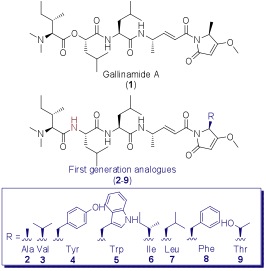
Figure 1 – Gallinamide A (1) and first-generation structural analogues (2-9).
The interesting pharmacological properties of gallinamide A prompted us to investigate this natural product as an antimalarial drug lead. The total synthesis and stereochemical assignment of gallinamide A was first carried out over seven steps in the longest linear sequence.1, 2 This synthesis was amenable to the preparation of structural analogues (e.g. 2-9, fig. 1) a number of which exhibited more potent anti-malarial activity than the gold-standard chloroquine against P. falciparum. We subsequently showed that these compounds exhibit their antimalarial activity through the inhibition of the food vacuole falcipains in P. falciparum, enzymes responsible for the degradation of host hemoglobin. This work has provided an opportunity to design and synthesize novel antimalarial drug leads that operate by completely novel modes of action to currently employed therapies for which significant resistance has emerged.
- Conroy, T.; Guo, J. T.; Hunt, N. H.; Payne, R. J. Total Synthesis and Antimalarial Activity of Symplostatin 4. Org. Lett. 2010, 12(23), 5576-5579.
- Conroy, T.; Guo, J. T.; Linington, R. G.; Hunt, N. H.; Payne RJ. Total synthesis, stereochemical assignment, and antimalarial activity of gallinamide A. Chem. Eur. J. 2011, 17(48), 13544-13552.