Poster Presentation RACI Biomolecular Division Conference 2013
A novel and versatile synthesis of pseudaminic acid analogues (#71)
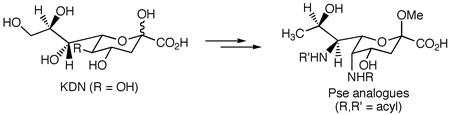
The pseudaminic acids are a unique class of nine-carbon carbohydrate monomers found naturally as structural glycan components within numerous clinically relevant Gram-negative pathogens.1 Structurally distinct from the sialic acids, pseudaminic acids (e.g. 1) have been shown to be important signalling molecules essential for the assembly of functional flagella in important motile human pathogens such as Helicobacter and Campylobacter.2,3 Whilst several structural analogues of pseudaminic acid have been isolated and characterised from pathogens such as Vibrio cholera and Pseudomonas aeruginosa,1,4 the exact role that this carbohydrate plays in the lifecycle and virulence of these pathogens remains to be determined.
As part of our ongoing research into the synthesis of novel carbohydrate derivatives that can be utilised in studies aimed at understanding the role and function of certain carbohydrate-utilising proteins, we have been interested in developing a novel and versatile synthetic approach towards the synthesis of pseudaminic acid and its analogues from a commercially available sialic acid derivative. Our versatile approach is the first of its type, in that there have been no reports of the synthesis of pseudaminic acid analogues, only three syntheses of pseudaminic acid itself. The pseudaminic acid analogues we have prepared will be utilised as probes to investigate the ways in which pathogenic bacterium utilise this important carbohydrate as a virulence factors.
- 1. Knirel, Y.A., Shevelev, S.D., Perepelov, A.V. (2011). Higher aldulosonic acids: components of bacterial glycans. Mendel. Comm. 21; 173-182
- 2. McNally, D.J., Schoenhofen, I.C., Houliston, R.S., Khieu, N.H., Whitfield, D.M., Logan, S.M., Jarrell, H.C., Brisson, J-R. (2008). CMP-pseudaminic acid is a natural potent inhibitor of PseB, the first enzyme of the pseudaminic acid pathway in Campylobacter jejuni and Helicobacter pylori. ChemMedChem. 3; 55-59.
- 3. Schirm, M., Soo, E.C., Aubry, A.J., Austin, J., Thibault, P., Logan, S.M. (2003). Structural, genetic and functional characterization of the flagellin glycosylation process in Helicobacter pylori. Mol. Microb. 48; 1579-1592
- 4. Knirel, Y.A., Vinogradov, E.V., L’vov, V.L., Kocharova, N.A., Shashkov, A.S., Dmitriev, B.A., Kochetkov, N.K. (1984). Sialic acids of a new type from the lipopolysaccharides of Pseudomonas aeruginosa and Shigella boydii. Carbohydr. Res. 133; C5-C8.