Poster Presentation RACI Biomolecular Division Conference 2013
Design and Synthesis of Derivatives of the Marine Bioluminescent Substrate Coelenterazine (#76)
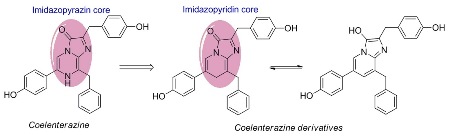
The luciferase from Renilla reniformis, which contains the natural substrate coelenterazine, is extensively studied and widely employed in molecular biology as a reporter gene in cell culture experiments and small animal imaging due to its bioluminescent property.1During the bioluminescence process, the degradation of the substrate coelenterazine is catalysed by the enzyme in the presence of molecular oxygen, resulting in the product coelenteramide, carbon dioxide, and the desired photon of light. In order to understand the luciferase mechanism, it is essential to obtain the tertiary structural information of the protein with its substrate coelenterazine, or an inhibitor that closely resembles it, such as imidazopyridin derivatives. Previous reports show that coelenterazine is unstable and not available for crystallography.2 Our current work focuses on the design and synthesis of novel coelenterazine-like imidazopyridin derivatives for the development of specific protein complex crystals to uncover the luciferase mechanism
- Contag, C. H.; Spilman, S. D.; Contag, P. R.; Oshiro, M.; Eames, B.; Dennery, P.; Stevenson, D. K.; Benaron, D. A. Photochem. Photobiol. 1997, 66, 523–531.
- Leoning, A. M.; Fenn, T. D.; Gambhir, S. S. J. Mol. Biol. 2007, 274, 1017-1028.