Poster Presentation RACI Biomolecular Division Conference 2013
Synthesis of novel porphyrins that are designed to be biocompatible (#91)
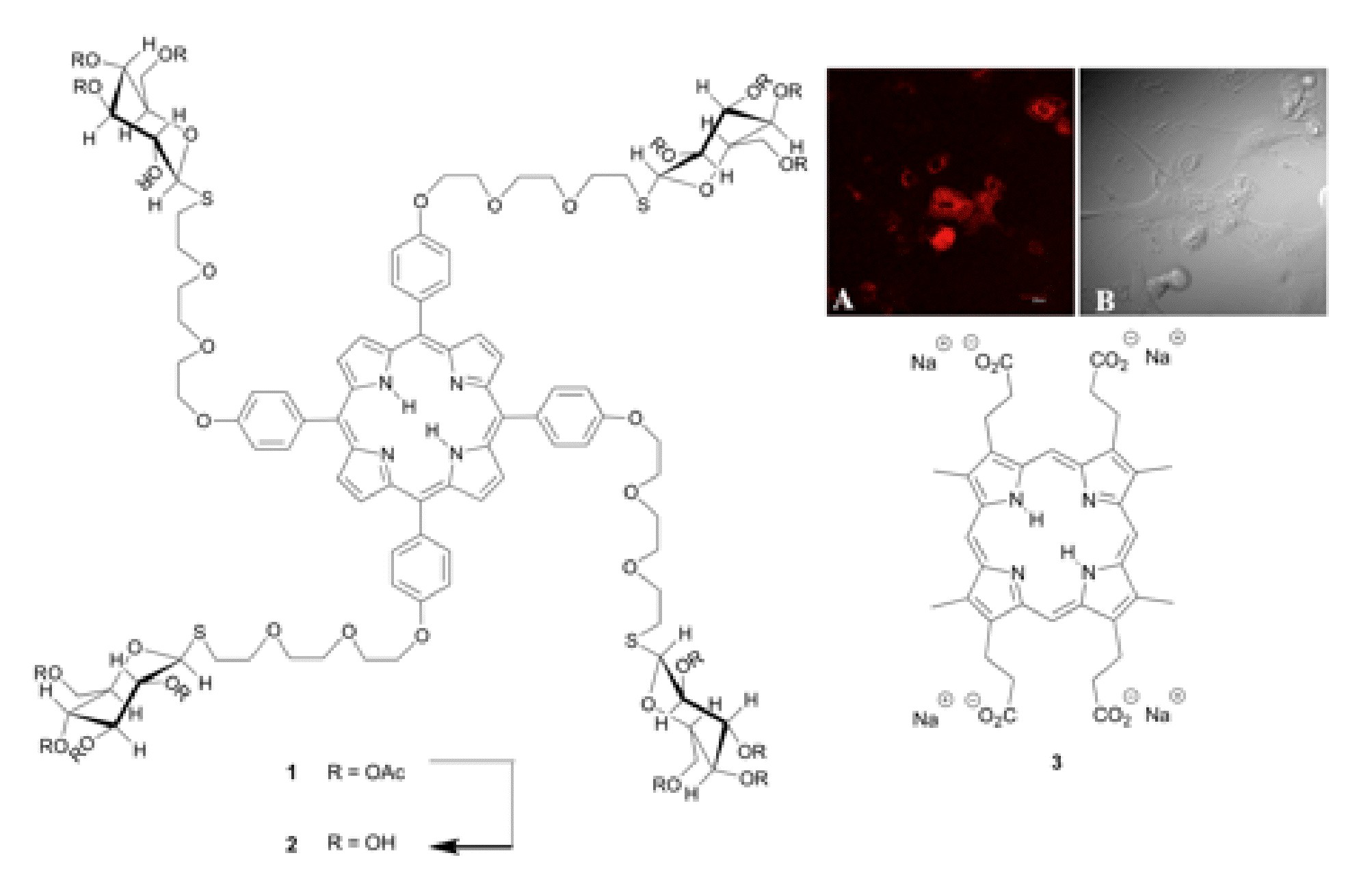
Porphyrins based on the protoporphyrin IX motif are used in many important natural systems such as oxygen carrying by haemoglobin and in photosynthesis. In order to expand their uses in biological systems, use can be made of non-natural porphyrins provided that they can be made biocompatible. The synthesis of drugs with suitable solubility remains a key challenge in drug applications. Sugar adducts allow a drug to target specific cells or cell structures in vitro.1,2,3Inthis research we have synthesised hybrid S-glycan porphyrins 1 and 2 with triethyleneglycol linkers in good yield to aid membrane penetration and water-solubility. These sugar moieties are attached to the 5-, 10-, 15-, and 20- positions on the porphyrin. This compound has low water solubility. Compound 3 (CPPII) was synthesised and characterised completely for the first time and is soluble in PBS up to 40 mM in concentration when 0.0006 M NaOH is used as an additive. CPPII localises in degenerate but viable A549 lung cancer cells (confocal fluorescence image A and brightfield image B.
Polyethylene glycol4 (PEG400) and ethanol have been used as
an additive in drug formulations but there is a limit to the amount of additives that can be added as these
alone can harm cells. Some toxicity data of PEG400 and ethanol, in lung cancer and
colorectal cancer cells, will be highlighted. The compounds synthesised can be
incorporated into cells and further studies may show their potential in
photodynamic therapy (PDT).5
- Laville, I. et al. J. Med. Chem. 2006, 49, 2558.
- Hirohara, S. et al. Bioconjugate Chem., 2012, 23, 1881.
- Tomé, J. P. C. et al. Bioorg. Med. Chem., 2007, 15, 4705-4713.
- Aerts, I. et al. Photodiagn. Photodyn. Ther., 2010, 7, 275-283.
- Ethirajan, M. Chem. Soc. Rev. 2011, 40, 340.