Poster Presentation RACI Biomolecular Division Conference 2013
Development of Small Molecule Chemical Tools for Labelling Carbonic Anhydrase IX in Tumour Hypoxia (#97)
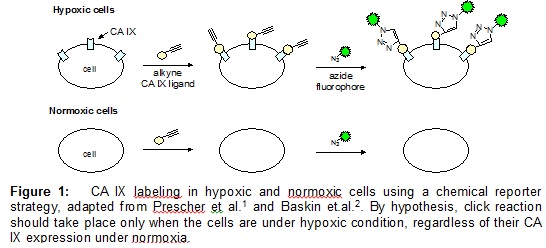
Biolabelling has emerged as a powerful tool in localizing and visualizing target biomolecules, including macromolecules such as proteins and enzymes. In contrast to other major biolabelling techniques that utilize relatively large proteins/antibodies as the means of labeling, a chemical reporter strategy takes advantage of small-sized molecules to label the target biomolecule.1, 2 Click chemistry, more specifically the reaction of organic azides and terminal alkynes (copper-catalysed azide-alkyne cycloaddition, CuAAC), is a suitable method for ligating the chemical reporter and the fluorophore due to the selectivity and simplicity of the reaction.3 The reaction proceeds rapidly in presence of Cu(I) catalyst; however, activated cyclooctyne compounds are capable of performing the same cycloaddition reaction without the Cu(I) catalyst, avoiding cytotoxicity exhibited by the metal species for living cell biolabelling applications.4
Carbonic anhydrases (CA), the target enzyme of this project, are ubiquitous zinc metalloenzymes responsible for a reversible conversion of CO2 and water into a proton and bicarbonate ion. The membrane-bound CA IX isozyme serves as a marker for tumour hypoxia, since it gets overexpressed under hypoxic conditions associated with most solid tumours.5
This project will involve the synthesis of a classical CuAAC and later-generation cyclooctyne compounds, both carrying a sulfonamide moiety for enzyme-substrate recognition with CA IX. The compounds will be subjected to biolabelling experiments using various tumour cells expressing CA IX under different oxygen conditions to test the efficiency of the synthesized alkyne/azide sulfonamide compounds in (i) binding to the enzyme and (ii) their ability to perform the subsequentclick reaction with a counterpart fluorophore for visualization. This study will provide a simple tool for studying tumour hypoxia and, moreover, the biolabelling experiment may link the effect of oxygen level in the tumour microenvironment to the molecular recognition between CA IX and the sulfonamide compounds.
- Prescher, J. A.; Bertozzi, C. R. Chemistry in living systems. Nat. Chem. Biol. 2005, 1, 13-21.
- Baskin, J. M.; Bertozzi, C. R. Bioorthogonal Click Chemistry: Covalent Labeling in Living Systems. QSAR Comb. Sci. 2007, 26, 1211-1219.
- Tron, G. C.; Pirali, T.; Billington, R. A.; Canonico, P. L.; Sorba, G.; Genazzani, A. A. Click chemistry reactions in medicinal chemistry: Applications of the 1,3-dipolar cycloaddition between azides and alkynes. Med. Res. Rev. 2008, 28, 278-308.
- Baskin, J. M.; Prescher, J. A.; Laughlin, S. T.; Agard, N. J.; Chang, P. V.; Miller, I. A.; Lo, A.; Codelli, J. A.; Bertozzi, C. R. Copper-free click chemistry for dynamic in vivo imaging. Proc. Natl. Acad. Sci. U. S. A. 2007, 104, 16793-16797.
- Supuran, C. T. Carbonic anhydrases: novel therapeutic applications for inhibitors and activators. Nat. Rev. Drug Discovery 2008, 7, 168-181.