Poster Presentation RACI Biomolecular Division Conference 2013
Access to a novel class of anti-tumour mutual prodrugs (#104)
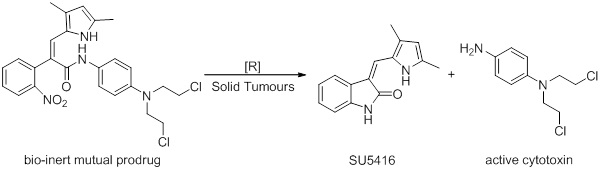
The unique micro-environment within solid tumours provides opportunities for the selective activation of prodrugs. One aspect of this environment is an increased reductive potential due to lower than usual pH and oxygen concentration. A mutual prodrug scaffold through which this could be exploited was envisioned, consisting of a hypoxia-activated 2-nitrophenylacetate prodrug of SU5416 and an inactivated cytotoxin bound through an ester or amide linkage (see figure). Eleven precursor molecules containing a 3-(3,5-dimethyl-1H-pyrrol-2-yl)-2-phenylacrylate scaffold were synthesised in the development of a Knoevenagel condensation between phenylacetic esters/amides and N-methyl carbamate-protected 3,5-dimethyl-1H-pyrrole-2-carbaldehyde. The compounds were tested for angiogenesis using a modified rat aortic ring assay. Derivatives with small ester side chains proved to be potent angiogenesis inhibitors while derivatives linked with amides and larger side chains did not. These side chains can be substituted with cytotoxins and other anti-cancer molecules to form hypoxia-activated mutual prodrugs selective for hypoxic tumours.