Poster Presentation RACI Biomolecular Division Conference 2013
Dimerization of Sansalvamide A inhibits the dimer protein: Heat Shock Protein 90 (#106)
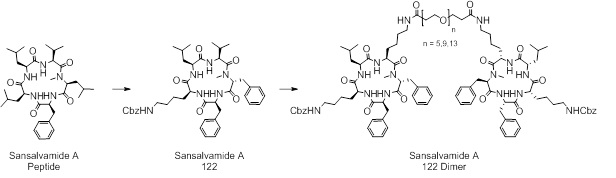
Heat shock protein 90 (Hsp90) accounts for 1-2% of the total proteins in normal cells and it functions as a dimer. Hsp90’s primary function is as a molecular chaperone that folds, assembles and stabilizes client proteins involved in cancer progression. Sansalvamide A, a novel hsp90 inhibitor, binds to the N-Middle domain of hsp90 and allosterically disrupts the binding of hsp90’s C-terminal domain proteins.1 Since hsp90 functions as a dimer, the dimerized sansalvamide A analog acts to inhibit the dimer of Hsp90. Utilizing our lead compound, Sansalvamide A 122 (San A 122)2, and a PEG linker, we developed several analogs of the dimerized sansalvamide A. Bioactivity study indicates that the PEG-9 dimer shows comparable ability to San A 122 in inhibiting hsp90’s chaperone function but enhanced effect on interfering the binding between hsp90 and its co-chaperones.
- Vasko, R. C.; Rodriguez, R. A.; Cunningham, C. N.; Ardi, V. C.; Agard, D. A.; McAlpine, S. R., Mechanistic Studies of Sansalvamide A-Amide: An Allosteric Modulator of Hsp90. ACS Medicinal Chemistry Letters 2010, 1, 4-8.
- Sellers, R. P.; Alexander, L. D.; Johnson, V. A.; Lin, C.-C.; Savage, J.; Corral, R.; Moss, J.; Slugocki, T. S.; Singh, E. K.; Davis, M. R.; Ravula, S.; Spicer, J. E.; Oelrich, J. L.; Thornquist, A.; Pan, C.-M.; McAlpine, S. R., Design and synthesis of Hsp90 inhibitors: Exploring the SAR of Sansalvamide A derivatives. Bioorganic & Medicinal Chemistry 2010, 18, 6822-6856.