Oral Presentation RACI Biomolecular Division Conference 2013
Textured Drug Discovery: Uncovering Enriched SAR of M1 Muscarinic Receptor Allosteric Modulators (#20)
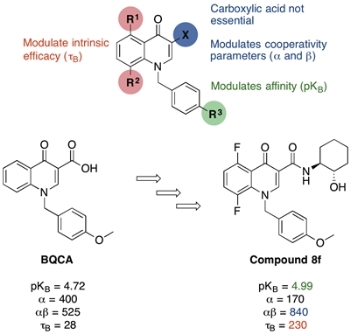
Established symptomatic therapies targeting Alzheimer’s disease generically focus on potentiation of the endogenous orthosteric ligand, acetylcholine, which acts at post-synaptic M1 muscarinic receptors in cortical and hippocampal brain regions to regulate cognitive function. Unfortunately, such therapies are invariably characterised by undesirable effects due to indiscriminate activation of other members of the muscarinic receptor family by acetylcholine. Due to high sequence conservation in the orthosteric binding site across these receptors, development of a truly M1 selective agonist has not been achieved. M1 muscarinic positive allosteric modulators/allosteric agonists, exemplified by benzyl quinolone carboxylic acid (BQCA), offer an attractive solution to this problem, because they target binding sites that are less conserved between receptor subtypes. In this study, we applied a rigorous allosteric receptor model analysis to a novel series of BQCA analogues to develop an "enriched" SAR defining the effects of structural modifications on allosteric ligand affinity (KB) for the allosteric site on the M1 receptor, efficacy (τB), and binding (α) and functional (β) modulation of acetylcholine. Ultimately, development of such enriched SAR surrounding allosteric modulators is anticipated to provide a more thorough mechanistic explanation for their mode of action, and ultimately allow tailored allosteric ligands to be developed.