Oral Presentation RACI Biomolecular Division Conference 2013
Chemical approaches to studying oxidative stress in biology (#11)
Disturbances in the redox potential of biological systems have wide-ranging effects, disrupting signaling pathways and contributing to disease. Oxidative stress is particularly important in diseases of ageing, such as cardiovascular disease, diabetes, obesity and neurodegenerative diseases. The challenge to understanding the links between oxidative stress and disease is the development of new ways to image redox state within cells.
While there are now many sophisticated imaging techniques to study biological systems, chemists hold the key to understanding what is happening in the cell, on a molecular level. We are interested in designing small molecule sensors to probe sub-cellular molecular events such as redox state.
We have developed first-generation redox-responsive sensors that are able to report on oxidative stress in biological systems, which we are applying to various disease systems. Our probes utilise biologically-derived groups as the sensing moieties, and signal changes in redox state by changes in fluorescence or modulation of magnetic resonance (MR) contrast.
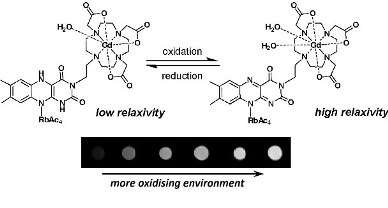
In particular, we have developed the first reversible, redox-responsive MR contrast agent, RG1, based on the commonly-used Gd-DO3A scaffold and a riboflavin sensing group. RG1 exhibits a two-fold increase in relaxivity (r1) upon oxidation, due to a change in the hydration state of the metal. The probe operates at biologically-relevant reduction potentials, is able to detect changes in oxidised to reduced glutathione at cellular concentrations, and gives measurable changes in phantom images of the complex in a commercial MRI machine.
We have also demonstrated useful strategies for reversible fluorescent redox sensors, which are fluorescent in oxidised form and non-fluorescent when reduced. We are now using these sensors in cellular studies, and developing further analogues with modulated reduction potentials and fluorescence output.