Oral Presentation RACI Biomolecular Division Conference 2013
Advancing Flow Chemistry: Towards Total Flow Synthesis (#5)
In contrast to the majority of scientific disciplines, the technologies and methodologies employed to perform synthetic chemistry have fundamentally remained unchanged for over a century.1-4 However, making the transition from inefficient and waste intensive processes requires a significant change in both approach and available technologies. In this respect, flow reactors and continuous flow processing technologies are an emerging and potentially viable alternative to wasteful conventional synthetic processing. Briefly, flow reactors are tubular or chip-based systems in which reagent streams are continuously pumped through reaction chambers and/or columns containing solid-supported reagents and chemical scavengers. Compared to tradition batch chemistry processing, the advantages of flow chemistry are numerous and include faster reactions, cleaner products, safer reactions, quick reaction optimisation, easy scale-up, and the integration of typically separate processes such as work-up and analysis.2-4
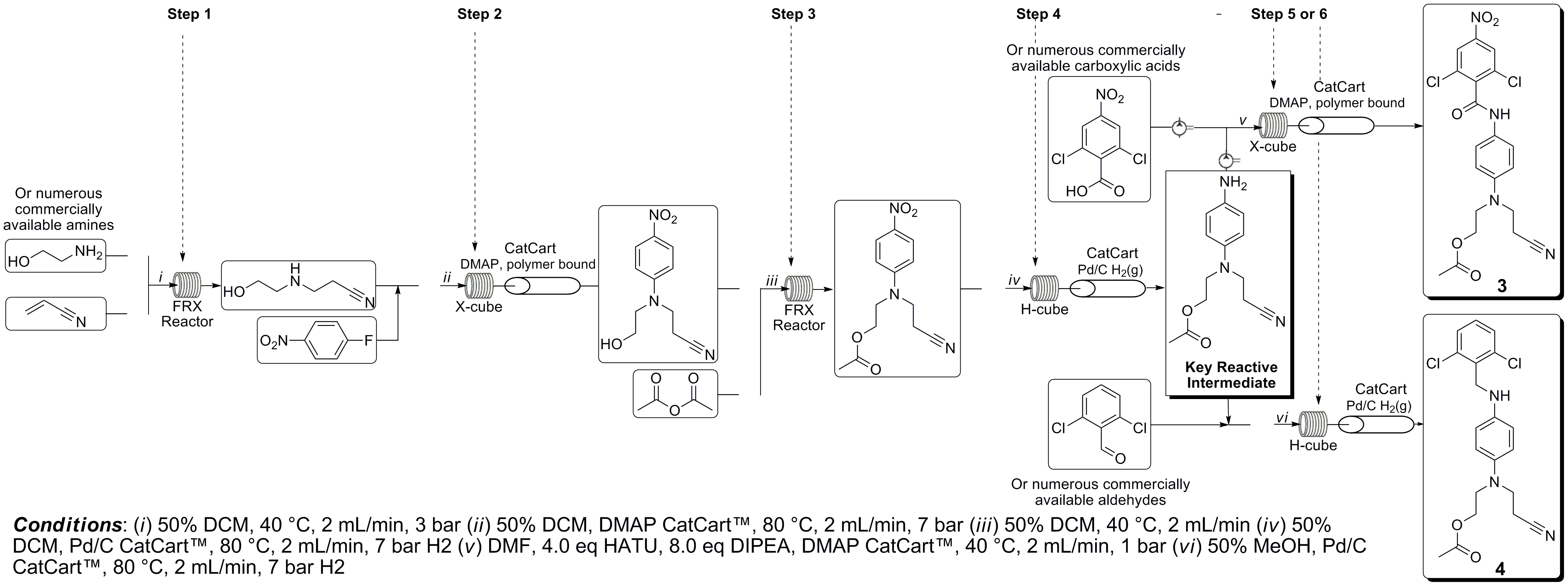
In order to investigate the utility of flow in medicinal chemistry spheres we are focusing our investigations on reactions fundamental to medicinal chemistry. Figure 1 serves as example of our approaches; this scheme incorporates a Michael reaction, an aromatic nucleophilic addition, an esterification, a nitro reduction, amide formation, and reductive amination. Further this synthetic strategy provides enormous scope for diverse analogue synthesis. Specifically, a plethora of amines can be utilised in step 1, numerous anhydrides can be introduced in step 3, whilst a diverse array of carboxylic acids or aldehydes can be exploited in step 5 and 6, respectively.
Scheme 1: Total-flow-synthesis protocol to access a series of nitrile-based analogues.
Additionally we are investigating a range of organometallic transformations including Suzuki and Heck reactions and have made significant advancements towards combinatorial synthesis. Herein we discuss these investigations comparing batch reactions with flow and demonstrate the benefits that flow can bring to medicinal chemistry.
1234
- Ahmed-Omer, B.; Sanderson, A. J. Organic & Biomolecular Chemistry 2011, 9, 3854.
- Hartman, R. L.; Jensen, K. F. Lab on a Chip 2009, 9, 2495.
- Wiles, C.; Watts, P. Green Chemistry 2012, 14, 38.
- Browne, D. L.; Baumann, M.; Harji, B. H.; Baxendale, I. R.; Ley, S. V. Organic Letters 2011, 13, 3312.