Oral Presentation RACI Biomolecular Division Conference 2013
Tetraethyl- and tetramethyl- nitroxides are potent inhibitors of the key neutrophil-derived inflammatory enzyme myeloperoxidase (#13)
Damage generated by the powerful oxidant HOCl (hypochlorous acid) generated by the myeloperoxidase (MPO)-H2O2-Cl- system of activated white cells is associated with multiple human inflammatory diseases. Consequently, there is considerable interest in therapeutically-useful MPO inhibitors. Nitroxides are well-established antioxidants of low toxicity that can attenuate oxidative damage in animal models of inflammatory disease. This activity has been postulated to arise from the superoxide dismutase or radical scavenging activity of nitroxides. We have shown (Biochem J, 2009, 421, 79–86) however that nitroxides can be potent inhibitors of MPO activity by interfering with the MPO enzymatic cycle. Thus 4-aminoTEMPO inhibited HOCl production by MPO and neutrophils with IC50 values of ~1 and ~6µM respectively. The utility of these nitroxides in vivo is however limited by the rapid reduction of tetramethyl-nitroxides to the hydroxylamine by ascorbate and other reductants.
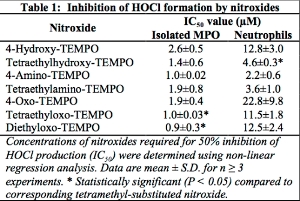
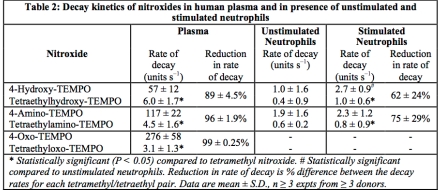
In the current study we have examined whether tetraethyl-substituted nitroxides, which have longer plasma half-lives, are effective MPO inhibitors. It is shown that a series of tetraethyl-substituted nitroxides retain the inhibitory activity against HOCl formation by both isolated MPO and activated human neutrophils (Table 1), and furthermore that these species have much slower rates of reduction by human plasma, unstimulated and stimulated neutrophils (Table 2).
This combination of much longer biological half-life and similar inhibitory capacity of myeloperoxidase by the tetraethyl nitroxides suggests that these compounds may have considerable promise as therapeutic agents for the inhibition of myleoperoxidase-mediated damage in inflammatory diseases.