Oral Presentation RACI Biomolecular Division Conference 2013
Synthetic Strategies on Polycyclic Frameworks for Blood-Brain Barrier Penetration. (#16)
Polycyclic cages have become valuable frameworks in drug development, particularly when pursuing targets within the central nervous system (CNS).1-3 Their rigid hydrocarbon scaffold provides improved metabolic stability and allows substituents to be precisely positioned in all three dimensions. Additionally, their dense lipophilic construct satisfies hydrophobic binding pockets and facilitates transference across the blood-brain barrier (BBB). Unfortunately, there is occasionally a trade-off between polycycle size and higher lipophilicity.
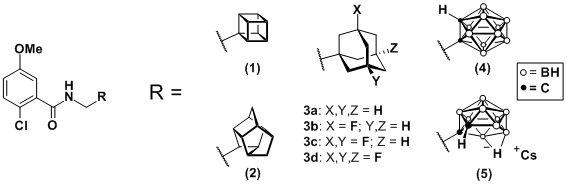
During our investigation into the P2X7 receptor inhibitors to target depression, we investigated a series of polycyclic cages (1-3a) to explore structure-activity relationships (SARs) and to optimise potency. Adamantane 3a was established as the ideal size for P2X7 receptor binding but failed to cross the BBB presumably due to high lipophilicity. To overcome this, we are exploring fluorinated analogues of adamantane (3b-d) which show drastically improved physicochemical properties. An alternative approach taken is to substitute adamantane 3a for closo-carborane 4 which provides an equally-sized polycycle that was de-boronated to generate the ionised nido-carborane cage 5. This ionic carborane now crosses the BBB and is the first case of a carborane possessing CNS-modifying activity.
In this presentation, the involvement of the P2X7 receptor in depression will be reviewed. The synthesis of various polycyclic frameworks from cubanes to carboranes, including access to fluorinated adamantanes, will be outlined along with their evaluation in functional cell assays and behavioural studies. We report novel strategies to “switch-on” BBB penetration for previously CNS-inactive polycycles.
- Issa, F.; Kassiou, M.; Rendina, L. M. Chemical Reviews 2011, 111, 5701.
- Lamoureux, G.; Artavia, G. Current Medicinal Chemistry 2010, 17, 2967.
- Joubert, J.; Geldenhuys, W. J.; Van der Schyf, C. J.; Oliver, D. W.; Kruger, H. G.; Govender, T.; Malan, S. F. ChemMedChem 2012, 7, 375.