Oral Presentation RACI Biomolecular Division Conference 2013
Design and synthesis of metabolically stable LRRK2 inhibitors for Parkinson’s disease (#18)
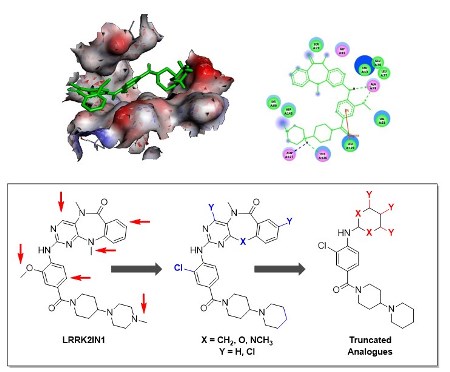
Leucine-Rich Repeat Kinase 2 (LRRK2) is a novel target for the development of neuroprotective therapeutics to treat Parkinson’s disease. The elevated enzyme activity of mutant LRRK2 has been implicated in the aetiology of neurodegeneration, the production of reactive oxygen species and a reduction in synaptic dopamine concentrations, in both in vitro and animal models.1,2 Recently, the selective benzodiazepinone compound LRRK2IN1 has been used to demonstrate the physiological benefits of inhibiting LRRK2 enzyme activity.3, 4 LRRK2IN1 is a highly potent inhibitor, exhibiting a half-maximal inhibitory concentration (IC50) of 9 nM in cellular assays. However, owing to poor physicochemical and pharmacokinetic parameters LRRK2IN1 is not biologically available in the brain.4 In silico modelling predicted six primary metabolites of LRRK2IN1. The physicochemical properties of the fully biotransformed metabolite were predicted to prevent penetration of the blood-brain barrier. A series of analogues were designed through incorporating pharmacologically proven bioisosteres to circumvent oxidative metabolism.5 Protein docking studies in a homology model of the LRRK2 kinase domain were used to validate design decisions and select promising analogues for synthesis. Initial biological analysis of a small library of analogues suggested that truncated compounds, lacking the diazepinone core, were equipotent to LRRK2IN1. The reduced molecular weight and lipophilicity of the truncated analogues prompted the synthesis of a second compound library to probe the importance of the aromatic motif. This presentation will detail our use of in silico modelling to rationally modify the scaffold of LRRK2IN1 and the chemical synthesis of inhibitors predicted to have improved drug-like characteristics. Results from current biological analyses and future research directions will be highlighted. Success in this area will provide the first disease-modifying treatment for Parkinson’s disease.
- Li, Y., et al., Nat. Neurosci. 2009, 12, 826.
- West, A. B., et al., Proc. Natl. Acad. Sci. U. S. A. 2005, 102, 16842.
- Lee, B. D., et al., Nat. Med. 2010, 16, 998.
- Deng, X., et al., Nat. Chem. Biol. 2011, 7, 203.
- Meanwell, N. A., J. Med. Chem. 2011, 54, 2529.