Oral Presentation RACI Biomolecular Division Conference 2013
Synthetic Approaches to a Peptide Isostere to Study Enzyme Mechanism (#6)
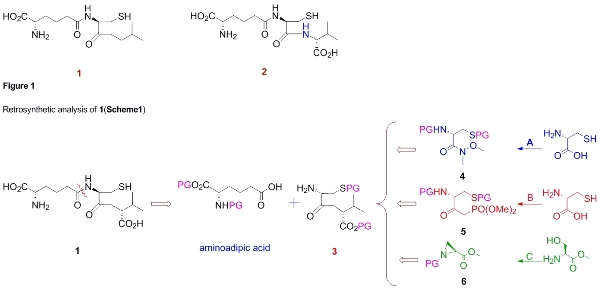
Non-ribosomal peptides are a class of microbial secondary metabolites possessing a variety of biological activities, which range from antimicrobial to immunosuppressive, to cytostatic and antitumor.12 The design and synthesis of metabolically stable peptide analogues which selectively mimic or inhibit the in vivo action of natural peptides or enzymes is a promising field in bioorganic and medicinal chemistry research.34 Our underlying aim is to synthesize the analogue 1 of the non-ribosomal peptide δ-(L-α-aminoadipic)-L-cysteine-D-valine 2 and to assay this compound for enzyme inhibitory actions against proteases and oxidases.
Scheme 1
Three different synthetic pathways are being explored to the key dipeptide intermediate 3.
A Metathesis pathway: L-Cysteine was first converted to the Weinreb amide, and then to the vinyl ketone. This is to be coupled with a substituted acrylate ester in an olefin metathesis reaction with Grubbs’ II catalyst followed by an asymmetric hydrogenation.
B Horner-Wadsworth-Emmons (HWE) pathway: The phosphonate derivative of L-cysteine has been generated and subjected to a HWE reaction with t-butyl glyoxylate to yield an enone. Michael addition introduces the isopropyl group asymmetrically.
C Aziridine pathway: L-Serine methyl ester has been transformed to a protected aziridine 6 and, utilizing the HWE strategy, to an alternative enone. Michael addition using a gold (III) chloride catalyst in aqueous medium introduces the isopropyl group successfully at the desired position.5 Nucleophilic attack to open the aziridine with a sulphur nucleophile then yields 3.
- Grünewald, J.; Marahiel, M. A. Microbiol. Mol. Biol. Rev. 2006, 70, 121-146
- Caboche, S.; Pupin, M.; Leclere, V.; Fontaine, A.; Jacques, P.; Kucherov, G. Nucleic Acids Res. 2008, 36, 326-331
- Venkatesan, N.; Kim, B. Curr. Med. Chem. 2002, 9, 2243-2270
- Ding, Y.; Rath, C. M.; Bolduc, K. L.; Hakansson, K.; Sherman, D. H. J. Am. Chem. Soc. 2011, 133, 14492-14495.
- Lipshutz, B. H.; Huang, S.; Leong, W. W. Y.; Zhong, G.; Isley, N. A. J. Am. Chem. Soc. 2012, 19985-19988.