Oral Presentation RACI Biomolecular Division Conference 2013
Raving mad? MDMA (‘ecstasy’) analogues for the treatment of Parkinson’s disease (#32)
L-DOPA therapy for Parkinson’s disease is almost inevitably associated with debilitating side-effects, most notably, a reduction in therapeutic duration, and involuntary movements known as L-DOPA-induced dyskinesia. For some time now it has been known that the illicit drug most commonly sold as ‘ecstasy’, methylenedioxymethamphetamine (MDMA, Figure 1), ameliorates the side-effects of levodopa therapy in animal models of PD, and (anecdotally) in a single human Parkinson’s sufferer. However, MDMA has no therapeutic potential in this context, primarily because it is psychoactive, causing an intense but unnatural euphoria, the basis of its abuse. Although controversial, there is also evidence that MDMA may be neurotoxic, or at least responsible for long-term, deleterious changes in brain chemistry. Thus, we set out to dissociate these undesirable attributes from the therapeutically useful activity.
In this presentation proof of concept and progress towards the identification of drug candidates will be described.
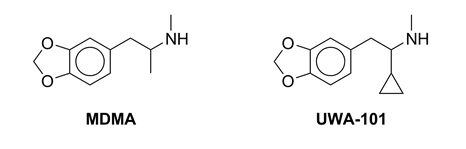
- “A novel MDMA analogue, UWA-101, that lacks psychoactivity and cytotoxicity, enhances L-DOPA benefit in parkinsonian primates”, T.H. Johnston, Z. Millar, P. Huot, K. Wagg, S. Thiele, D. Salomonczyk, C.J. Yong-Kee, M.N. Gandy, M. McIldowie, K.D. Lewis, J. Gomez-Ramirez, J.-Y. Lee, S.H. Fox, M. Martin-Iverson, J. E. Nash, M.J. Piggott, J.M. Brotchie, FASEB J, 2012, 26, 2154–63.
- “The monoamine re-uptake inhibitor UWA-101 improves motor fluctuations in the MPTP-lesioned common marmoset", P. Huot, T.H. Johnston, M.N. Gandy, M.G. Reyes, S.H. Fox, M.J. Piggott, J.M. Brotchie, PLoS 1, 2012, 9, e4558.
- “Characterization of 3,4-methylenedioxymethamphetamine (MDMA) enantiomers in vitro and in the MPTP-lesioned primate: R-MDMA reduces severity of dyskinesia, whereas S-MDMA extends duration of ON time”, P. Huot, T.H. Johnston, K.D. Lewis, J.B. Koprich, MG. Reyes, S.H. Fox, M.J. Piggott, J.M. Brotchie, J. Neurosci., 2011, 31, 7190 –719.