Oral Presentation RACI Biomolecular Division Conference 2013
A functional nanoreactor based on a Ru(II)bisterpyridine-cytochrome c bioconjugate light driven proton pump (#33)
Bio-hybrid nanoreactors that incorporate functional biological molecules such as proteins or enzymes within a confined space are of considerable interest, both as mimicks of organells and for the spatial control of reactions. To this end, polymersomes are emerging as an attractive option for encapsulation of proteins.1 What has been lacking though, and would also be useful for a range of application, are means to control the activity of these enzymes and proteins. This includes methods to “turn on” these systems as we all as more effective methods to encapsulate proteins in polymersomes.
Our approach to “turn on” these system uses chromophore-redox protein bioconjugates, namely metallobisterpyridine linked via maleimide-cysteine chemistry to cytochrome c. We previously reported the successful synthesis and photophysical characterisation of these bioconjugates2,3 which were then used in the current work in combination with Cytochrome c oxidase to generate the functional light-driven proton pump.
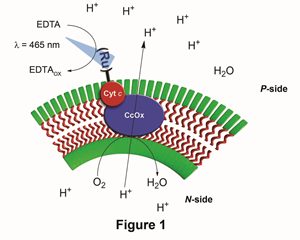
Further, we have recently shown that seemingly simple electrostatic interaction between proteins such as green fluorescent protein (GFP) and polystyrene140-b-poly(acrylic acid)48 (PS140-b-PAA48) diblock copolymer macromolecules can be used to induce the formation of polymersomes.4 Combining these advances, we were able to encapsulate in polymersomes a chromophore-labelled cytochrome c forming a complex with cytochrome c oxidase (Figure 1). This system combines key features of the photosynthetic and respiration systems in nature to create a proton gradient across a membrane upon excitation with light. Our preliminary results show that the resulting pH gradient can catalyse reaction in the interior of our bio-hybrid nanoreactor.
- Vriezema, D. M. et al.Angew. Chem. Int. Ed., 2003, 42, 772-776.
- Peterson, J. R. Smith, T. A., Thordarson, P. Chem. Commun., 2007, 1899-1901.
- Peterson, J. R. Smith, T. A., Thordarson, P. Org. Biomol. Chem., 2010, 8, 151-162.
- Hvasanov, D., Wiedenmann, J., Braet, F., Thordarson, P. Chem. Commun., 2011, 47, 6314-6316.