Oral Presentation RACI Biomolecular Division Conference 2013
Synthesis and evaluation of novel enzyme inhibitors as tuberculosis drug leads (#29)
Tuberculosis (TB), caused by infection with the bacterium Mycobacterium tuberculosis, has re-emerged as a global health risk with a significant proportion of new TB cases classified as multi-drug resistant (MDR) or extensively drug resistant (XDR). As such, there is a desperate need for the development of TB therapies which operate via novel modes of action.1
This talk will outline our efforts aimed at the rational design, synthesis and biological evaluation of novel inhibitors of type II dehydroquinase and GlmU uridyltransferase. The former is responsible for the biosynthesis of essential secondary metabolites in M. tuberculosis including folate, the aromatic amino acids and ubiquinones.2 The latter enzyme is involved in the biosynthesis of peptidoglycan, one of the main components of the mycobacterial cell wall.3
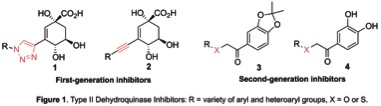
Initial efforts towards the development of type II dehydroquinase inhibitors involved mimicking the enol transition state of the enzyme (e.g. 1 and 2, Figure 1).4-6 Nanomolar enzyme inhibitors of this enzyme were developed, however, these exhibited only moderate anti-tubercular activity when evaluated against the virulent M. tuberculosis strain H37Rv.4 In order to improve permeability across the hydrophobic mycobacterial cell wall, a second-generation inhibitor library (e.g. 3 and 4, Figure 1) was designed and synthesised. These inhibitors proved to be less potent against M. tuberculosis type II dehydroquinase (inhibition constants: 5-40 µM). However, most compounds were significantly more potent inhibitors of M. tuberculosis growth when tested against M. tuberculosis (MIC50: 10-850 µM).6
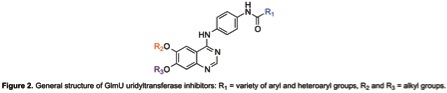
The development of the first inhibitors of M. tuberculosis GlmU will also be discussed. Specifically, the synthesis of inhibitors based on an aminoquinazoline scaffold as well as structure-activity data will be described (Figure 2).
- Global tuberculosis control: World Health Organization report 2012.
- Abell, C. in Enzymology and Molecular Biology of the Shikimate Pathway: Comprehensive Natural Products Chemistry (Ed: U.Sankawa), Pergamon, Elsevier Science, Oxford, 1999, pp. 573-607.
- Gehring, A.; Lees, W.; Mindiola, D.; Walsh, C.; Brown, E.; Biochemistry. 1996, 35, 579-585.
- Tran, A.; Cergol, K. M.; Britton, W. J.; Imran Bokhari, S. A.; Ibrahim, M.; Lapthorn, A. J.; Payne, R. J. Med. Chem. Commun. 2010, 1, 271-275.
- Tran, A.; Cergol, K. M.; West, N. P.;Randall, E. J.; Britton, W. J.; Imran Bokhari, S. A.; Ibrahim, M.; Lapthorn, A. J.; Payne, R. J. ChemMedChem. 2011, 6, 262-265.
- Tran, A.; West, N. P.; Britton, W. J.; Payne, R. ChemMedChem. 2012, 7, 1031-1043.