Oral Presentation RACI Biomolecular Division Conference 2013
Towards developing selective inhibitors of the protease Fibroblast Activation Protein (FAP) as a potential therapeutic for cancer and chronic liver injury (#25)
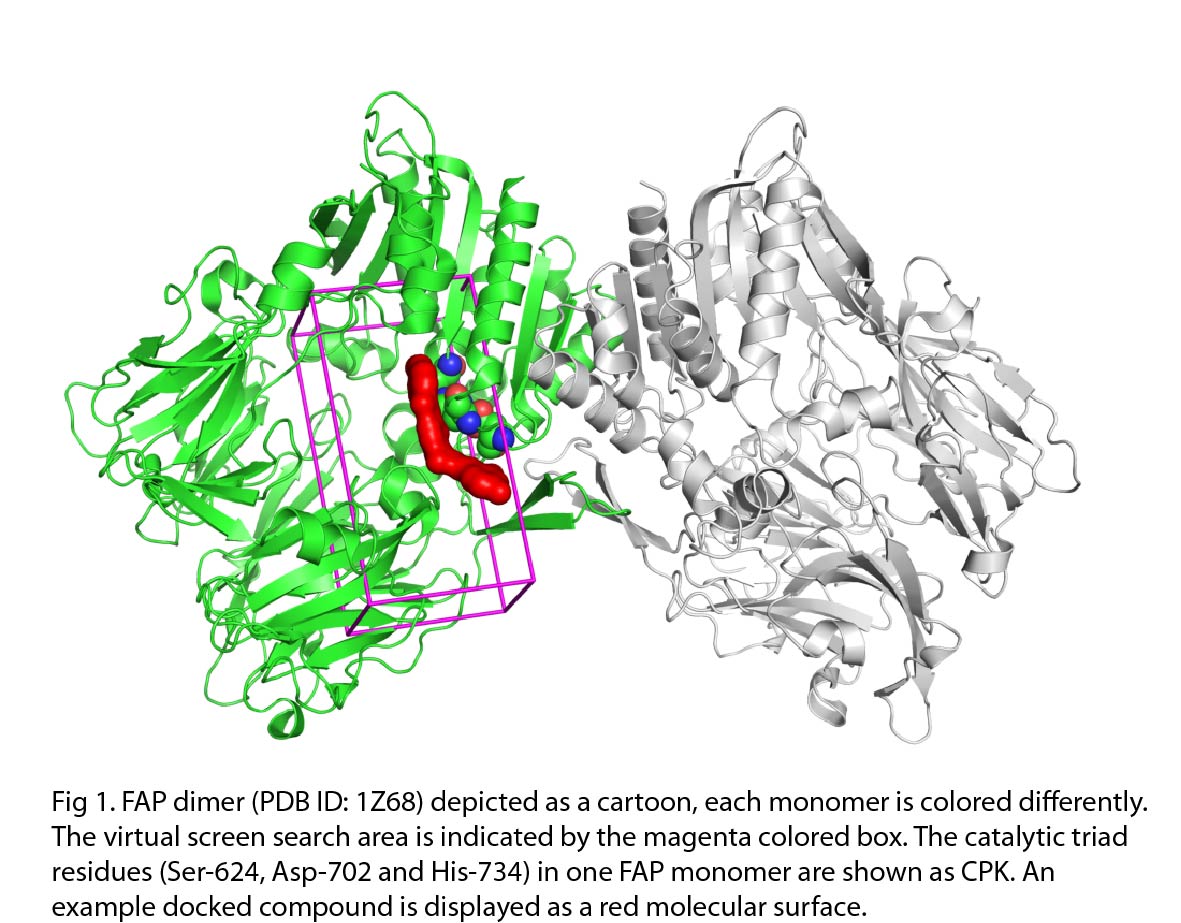 Fibroblast activation protein (FAP) is a serine protease that is widely thought to play a role in tumour growth and other diseases involving tissue remodelling (1-4). There is evidence that FAP drives chronic liver injury via pro-fibrogenic pathways and plays a role in the pathogenesis of type 2 diabetes mellitus (4). Targeting FAP may enable new therapeutic treatments for chronic liver injury. The FAP enzyme is unique in that it exhibits both exopeptidase and endopeptidase post-proline cleaving activities. A primary challenge in the development of a FAP inhibitor as a laboratory tool or potential therapeutic agent is achieving selectivity over the closely related enzymes dipeptidyl peptidase 4 (DPP4, an exopeptidase) and prolyl endopeptidase (PEP, an endopeptidase) (1-4). DPP4 is a therapeutic target for diabetes and PEP for brain disorders. With the purpose of identifying new FAP inhibitors, a virtual screen of the FAP active site was carried out using our in-house in silico compound library which consists of ~4 million “drug-like” small molecules available from commercial suppliers. The virtual screen was performed using Fred v2.2.5 (OpenEye Scientific Software, Inc., http://www.eyesopen.com) and the docked compound poses were ranked using the Chemgauss3 scoring function. The 2000 highest ranked compounds identified in the virtual screen were filtered to remove duplicate compounds and PAINS frequent hitters (5). The structural diversity of the remaining 1700 compounds was then calculated using Selector within Sybyl X-2.0 (Certara L.P., http://tripos.com) and a set of ~100 structurally diverse compounds were purchased. The ability of these compounds to inhibit FAP, DPP4 and PEP enzymes at 10μM and 50μM was determined. At 10μM 11 compounds inhibited FAP activity >80%, while 16 inhibited FAP activity >80% at 50μM. Twenty compounds displayed selectivity towards FAP over DPP4 or PEP and will be investigated further.
- 1. K Aertgeerts, I Levin, L Shi, G P Snell et al (2005). Structural and kinetic analysis of the substrate specificity of human fibroblast activation protein. J. Biol. Chem. 280:19441-19444.
- 2. Jansen K, Heirbaut L, Cheng JD, Joossens J, Ryabtsova O, Cos P, Maes L, Lambeir A-M, De Meester I, Augustyns K, Van der Veken P (2013). Selective inhibitors of fibroblast activation protein (FAP) with a (4-quinolinoyl)-glycyl-2-cyanopyrrolidine scaffold. ACS Med. Chem. Lett. In press.
- 3. Poplawski SE, Lai JH, Li Y, Jin Z, Liu Y, Wu W, Wu Y, Zhou Y, Sudmeier JL, Sanford DG, Bachovchin WW (2013). Identification of selective and potent inhibitors of fibroblast activation protein and prolyl oligopeptidase. J. Med. Chem. In press.
- 4. Wang XM, Yao T-W, Nadvi NA, Osborne B, McCaughan GW, Gorrell MD (2008). Fibroblast activation protein and chronic liver disease. Front. Biosci. 13:3168-3180.