Oral Presentation RACI Biomolecular Division Conference 2013
Effectively delivering a drug using star polymers: Improving solubility of a unique hsp90 inhibitor (#40)
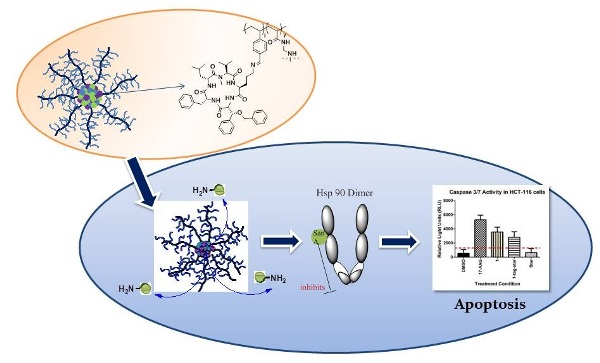
We have identified a novel molecule, Sansalvamide A 145 (S145), which is a natural product derivative that inhibits heat shock protein 90 (Hsp90). Clinically relevant Hsp90 inhibitors target the ATP-binding pocket within the N-terminal domain of Hsp90, and these molecules do not inhibit binding interactions between co-chaperone proteins and Hsp90’s C-terminal domain. Previously we have shown that S145 inhibits the formation of ionic interactions between the basic residues of client proteins and Hsp90’s acidic MEEVD region. Although these data suggest that S145 will overcome the current limitations of existing Hsp90-targeted drugs, the hydrophobicity of S145 has limited its potential as a viable clinical candidate. Drug delivery of this unique molecule via nanoparticles is one approach that could enhance the efficacy of S145 by delivering the molecule to the cell via endocytosis instead of passive diffusion. Herein we report the synthesis of a novel Hsp90 inhibitor conjugated to a star polymer. Using RAFT polymerization, we prepared star polymer comprised of PEG attached to a predesigned functional core. The star was cross-linked using disulfide linkers, generating nanoparticles that are easily degraded by the body. Star polymers are non-toxic, they reliably enter cells, and the drug payload is easy to calculate. The Hsp90 inhibitor, S145, release was studied at pH=1, 5 and 7.4; conditions representative of endosomal and extra cellular environments. We show via cytotoxicity studies and confocal analysis that using this nanoparticle delivery system improves the effectiveness of this Hsp90 inhibitor by five-fold. Further, like the parent compound, we showed that S145-polymers induce apoptosis by a caspase 3/7 dependent pathway. These studies show that we can deliver S145 into cells effectively using star polymers, and lower the dose of compound required to induce apoptosis.