Oral Presentation RACI Biomolecular Division Conference 2013
Natural Product Analogues as New Tuberculosis and Malaria Drug Leads (#44)
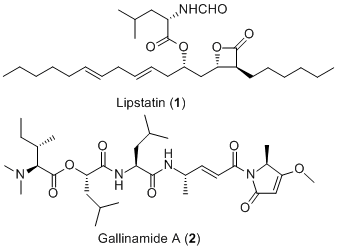
Natural products have provided inspiration for the development of a number of clinically approved drugs for infectious diseases.1 Two examples include rifampicin and artemisinin which serve as frontline therapies for the treatment of tuberculosis (TB) and malaria, respectively. The rapid emergence of resistant strains of Mycobacterium tuberculosis (the etiological agent of TB) and Plasmodium falciparum (the major cause of human malaria) has meant that new drugs with novel modes of action are desperately needed to prevent a potential pandemic. This talk will outline our efforts aimed at using natural products as privileged scaffolds for the discovery of anti-tubercular and anti-malarial agents. Examples will include analogues of lipstatin (1) (isolated from the Actinobacterium Streptomyces toxytricini) as novel anti-tubercular agents2 and derivatives of gallinamide A (2) as anti-malarials3,4 (Figure 1). The putative mode of action of these compounds will also be discussed.
- F. E. Koehn, G. T. Carter, Nature Rev. Drug Discov. 2005, 4, 206-220.
- N. P. West, K. M. Cergol, M. Xue, E. J. Randall, W. J. Britton, R. J. Payne, Chem. Commun. 2011, 47(18), 5166-5168
- T. Conroy, J. T. Guo, N. H. Hunt, R. J. Payne, Org. Lett. 2010, 12(23), 5576-5579
- T. Conroy, J. T. Guo, R. G. Linington, N. H. Hunt, R. J. Payne, Chem. Eur. J. 2011, 17(48), 13544-13552